

AWS, Microsoft, OpenAI, Anthropic, Google, and the Pentagon all built or bought forward deployed engineering (FDE) armies in the summer of 2026.
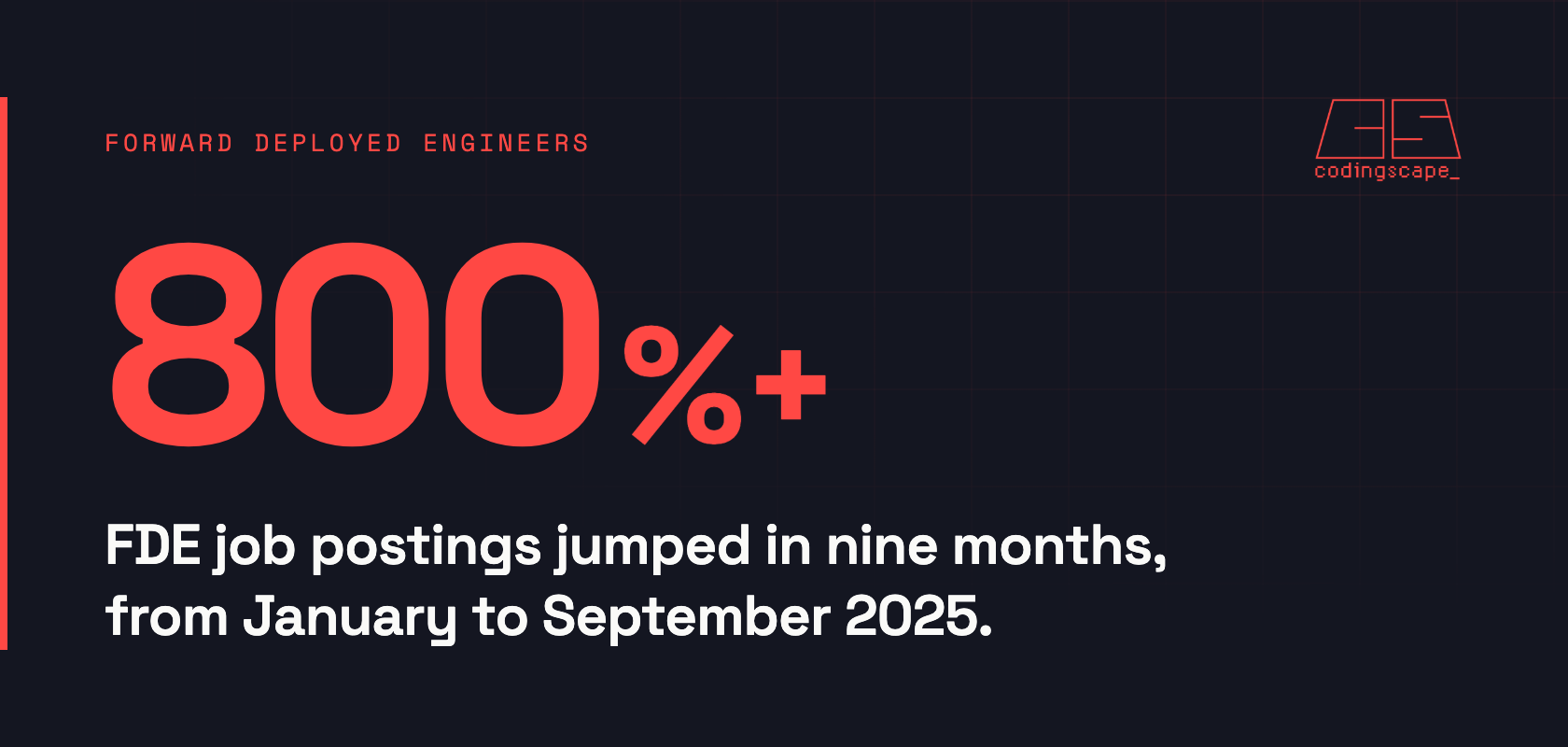
By the end of July, AWS had committed $1 billion to its own forward deployed engineering unit, Microsoft had launched a $2.5 billion "Frontier Company" with 6,000 people, OpenAI had made its second FDE acquisition, and the Pentagon had started recruiting forward deployed engineers to work inside military units.
Here's what FDEs actually do all day, why billions are suddenly flowing to deployment work, how the FDE role differs from consulting, and what it means for your team – whether you ever hire FDEs or not.
What FDEs actually do
A forward deployed engineer is a vendor's engineer who works inside your company, writing code, wiring integrations, and redesigning workflows until the vendor's AI systems run in your production systems.
Palantir popularized the title in the early 2010s, where the role was internally named Delta, embedding engineers with customers – mostly government agencies – to make its software work inside messy, real-world systems. For a decade the model stayed mostly Palantir's.
The job ads describe "innovator-builders" with a "founder's mindset" delivering "white glove" deployments. Gergely Orosz of The Pragmatic Engineer translated Google's FDE listing into plainer terms: roughly 25% coding, 50% integration and plumbing, and 25% meetings and customer hand-holding.
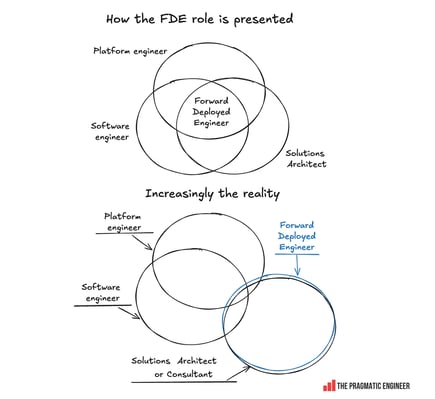
Strip the language and Bloomberry's analysis of 1,000 FDE postings lines up with Gergely Orosz's read of Google's listing:
- The daily work – 55% of postings center on direct customer work, 37% on building AI/ML systems, 32% on integrating systems and APIs. None mention a revenue quota.
- The required skills – Python (66% of postings), AI agent experience (35%), and TypeScript (35%).
- The typical background – software engineering (45%) or solutions engineering (22%), rarely traditional consulting.
- The pay – a median base salary of $173,816.
At AWS, pods of five to six engineers now run "agentic-first," 45-day sprints alongside AI agents – the NFL's pod shipped customer-facing features like NFL Fantasy AI and NFL IQ in weeks instead of quarters. When the sprint ends, the AI agents often stay behind with the customer's own engineers, who inherit both the system and the workflow that built it.
Five tech giants – and the Pentagon – built FDE orgs worth billions
In three months, five of the biggest names in tech – plus the Pentagon – committed roughly $9 billion between them to build dedicated FDE organizations.
Companies that spent the last decade competing on models and infrastructure are now competing on who can embed the most engineers inside customer orgs:
- Anthropic / Ode (May 4) – launched what's now named Ode with Anthropic, a $1.5 billion venture per CNBC. They acquired Fractional AI within weeks and now run roughly 100 engineers targeting mid-sized companies, historically a Fortune 500 luxury.
- OpenAI (May 11) – launched The OpenAI Deployment Company as a majority-owned standalone entity with more than $4 billion from 19 investors, led by TPG, Advent, Bain Capital, and Brookfield, at a reported $14 billion valuation. Acquired Tomoro (150 FDEs serving Tesco, Virgin Atlantic, and Supercell), then Northslope, a Palantir-rooted firm, on July 8.
- Google Cloud (May 12) – skipped the subsidiary and built in-house, listing 59 FDE roles across the US, London, Paris, and Hong Kong, with interviews compressed from 4–6 rounds to as few as 2 in 2 days.
- AWS (June 30) – put $1 billion behind a new Forward Deployed Engineering organization, embedding "thousands of experts" with customers including the NBA, NFL, Southwest Airlines, and Cox Automotive.
- The Pentagon (June 30) – launched War Force, recruiting hundreds of forward deployed engineers into two-year military assignments paying close to $200,000 a year.
- Microsoft (July 2) – answered with a $2.5 billion unit it calls Frontier Company, roughly 6,000 engineers and salespeople under newly appointed president Rodrigo Kede Lima, deploying engineers for free and billing through Azure AI consumption instead – the same playbook that built its cloud business.
Why FDEs now? Services just became AI's $6 trillion opportunity
Model capability is a shrinking differentiator. Frontier models leapfrog each other every few months, and enterprises increasingly treat them as swappable. What doesn't swap easily is the work of wiring AI into a company's actual systems – and that's where enterprise AI value has been stuck.
Sequoia Capital put a number on why the labs are chasing that work instead of the model layer. Its March 2026 thesis, "Services: The New Software," argues the next trillion-dollar company won't sell software at all – it will sell the services that build AI systems to deliver final outcomes:
- The ratio – for every dollar a company spends on software, it spends six on services.
- The market size – insurance brokerage, IT managed services, and staffing alone add up to hundreds of billions; add it up and services dwarfs the software market AI companies have spent a decade fighting over.
- The revenue mechanism – every embedded engineer who gets an AI workflow into production turns into sustained token consumption for their lab or cloud provider.
- The hedge – the private equity firms backing these ventures see the same math and bet on it anyway: OpenAI guaranteed its Deployment Company investors a 17.5% annual return over five years, an almost unheard-of floor for a venture-stage bet.
These same labs spent two years telling the market AI would replace jobs like consulting. Then they raised billions to build FDE AI implementation companies – and now the cloud platforms and the Pentagon have followed them in.
FDEs vs consultants: what's the difference?
So are these just consulting arms with new branding? The resemblance is hard to miss – standalone services entities, thousands of embedded engineers, private equity backers – and Gergely Orosz of The Pragmatic Engineer says as much. He reads the role as becoming hard to distinguish from a solutions architect, especially now that the jobs sit in quasi-external companies separated from where the AI products get built.
The consultancies aren't sitting this out. Accenture launched a Microsoft forward deployed engineering practice in March 2026, months before Frontier existed, and Frontier delivers partly through Accenture, Capgemini, EY, KPMG, and PwC. Microsoft's commercial CEO Judson Althoff rejected the label outright, writing that Frontier "goes beyond what has been labeled as Forward-Deployed Engineering."
The difference that matters is in the work:
- The outcomes – a consultant hands you an assessment, a roadmap, or a slide deck, and the building goes to someone else. An FDE hands you the running system, with code committed to your repos.
- The method – FDEs embed with your engineers rather than around them, pairing on integrations and redesigning workflows with the people who run them.
- The finish line – a consulting engagement ends with recommendations and a renewal conversation. An FDE engagement ends with something in production and a team that can operate it, because they helped build it.
- The people – FDE roles are staffed from software engineering, and measured on working deployments instead of hours billed.
Should I hire forward deployed engineers (FDEs)?
If your AI pilots keep stalling at the integration layer, if you're rolling out AI across business units, or if a vendor's FDEs are making architecture decisions you'll live with for years, then yes, you need this function, whatever you call it.
You may not need a job posting to get there. The skill profile – strong coding, systems thinking, business acumen, agent fluency – already describes your best integration-minded senior engineers. Pull them in before you hire for the title.
It's also the model Codingscape has run for years. We call it the anti-consultancy: senior, US-led teams measured on outcomes instead of billable hours, sized from two engineers to fifty as the work demands. The difference from the lab version is the incentive.
A lab's or cloud company's FDE gets paid to grow that platform's consumption. Ours get paid to make your system work, on your architecture, and the knowledge stays with your team when the engagement ends.
If that's the kind of AI implementation you need, let's talk about deploying FDEs at your company.
